Walking the Beans (Unexpected Trauma Lessons from a Kansas Soybean Field)
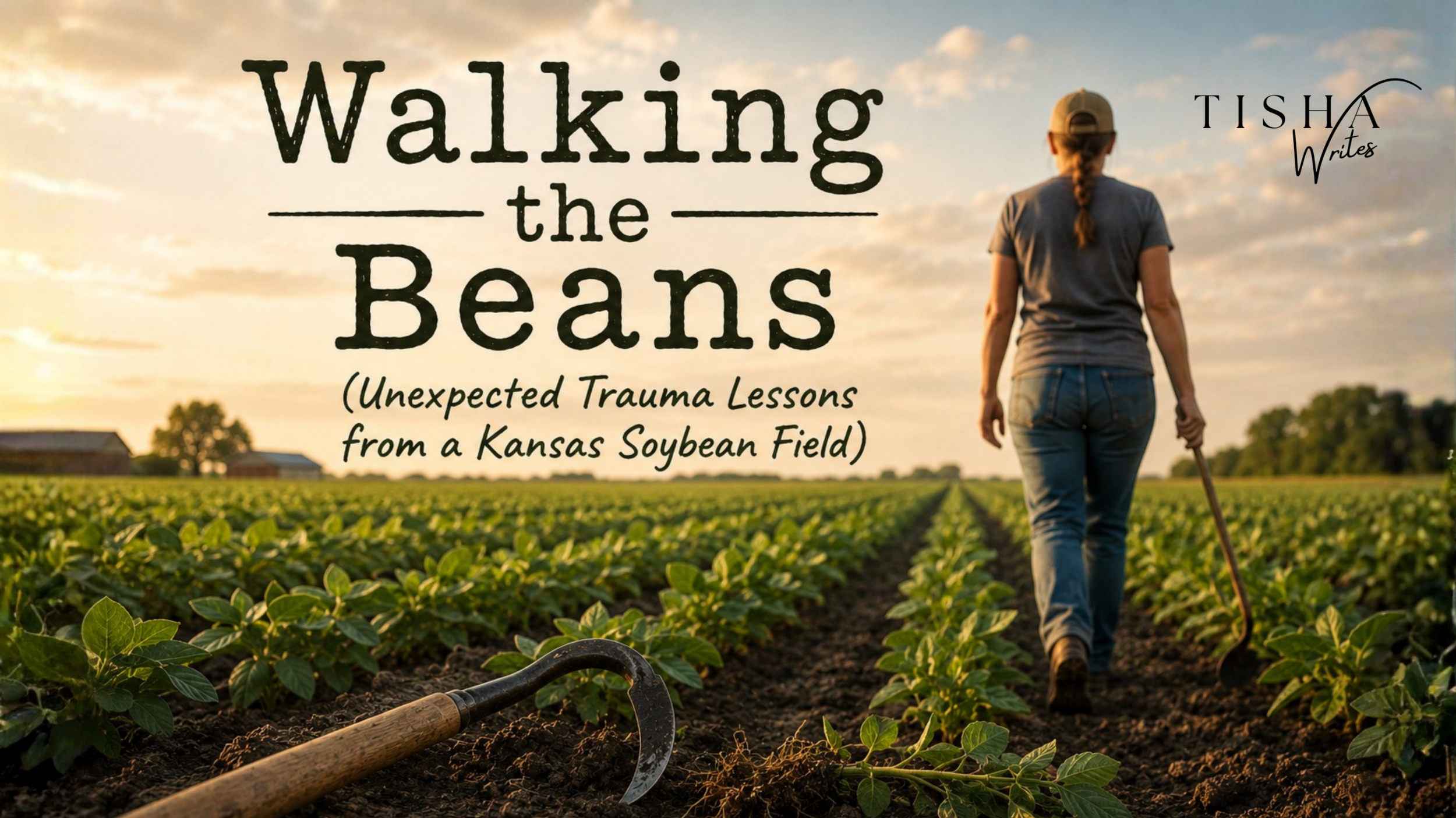
If you were not raised on a farm in Kansas, you likely have never heard of walking the beans.
Lucky you.
Walking the beans is what it sounds like. Every summer, before herbicides became the hero of soybean farming, my siblings and I went into the fields with bean hooks and bad attitudes.
Imagine it:
Knee-high soybeans.
Kansas heat.
Sweat dripping down your back.
The sun beating down as if it had a personal vendetta against you.
Grasshoppers threw themselves at your face like little devils.
And about nine million more rows to go.
They called it character-building.
I called it child labor.
Our job was straightforward:
Walk the rows.
Spot the weeds.
Kill the weeds.
Mostly giant sunflowers and button weeds.
The bean hook is a short, curved blade with a handle; you swung it low at the weed's base. However, one essential rule was:
You had to cut it below the first leaf. Or pull it out by the root. If one leaf remained, that weed would return.
And if it did come back?
Congrats.
You get to walk the beans again.
I found that rude.
At the time, I hated it every minute of it. Walking the beans was a trauma in itself. And, to be fair, perhaps it was. Only recently have I realized it taught me something I could not appreciate until much later:
Healing trauma is much like walking the beans.
Some of these painful memories are like tiny weeds. Some are massive wild sunflowers with roots stretching down to hell. But they all obey one rule:
If you cut off only what you can see, it will grow back.
For a long time, I thought healing was about better managing my reactions.
Be calm.
Be nice.
Don't overreact.
Don't get triggered.
Take a breath.
Count to ten.
Drink some water.
Pretend to be emotionally mature.
Sometimes that works.
Sometimes, it just trims the leaves.
Because if the root remains, it keeps growing back.
The anger returns.
The fear comes back.
The defensiveness returns.
The shutdown returns.
The people-pleasing returns.
The spiral returns in disguise, claiming it is a different issue.
Different day.
Same weed.
Real healing started when I stopped asking:
“Why did I react like that?”
…and started asking:
“Where did that reaction come from?”
What memory does this connect to? What old hurt does this remind me of? What belief about myself got planted here years ago that I’m still responding to like it’s happening in real time?
That is root work.
And root work is harder.
It takes longer.
It is messier.
Far less fun. Much like walking beans in July. But when you get to the root and really work it there, something changes.
A trigger can still happen. But it no longer owns you. It will not hijack your nervous system and send your emotions plunging off a cliff.
It just... is.
Like seeing a dead weed lying in the row behind you. It’s like having a memory with no pain attached to it.
Handled. Done. No leaves left. No growing back.
I never thought bean hooks and emotional healing would meet somewhere in my life. But here we are.
As it turns out, the farm taught me more than I thought.
Somewhere between those soybean rows, button weeds, and the heat-induced childhood exhaustion, I learned trauma recovery.
I would have preferred a less sweaty lesson. But wisdom does not always enter a therapist's office. Sometimes, it enters a soybean field...
with a bean hook...
with dirt on your shoes...
and grumbling under your breath about how many rows are left.